
Interview with Jay Miner
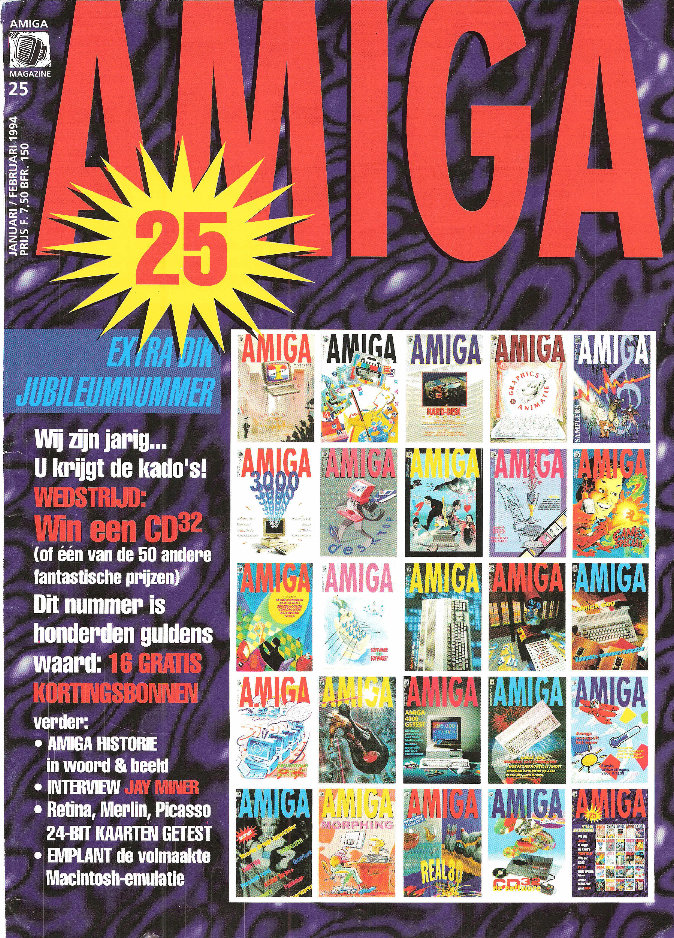
This interview with Jay Miner was originally published in the January/February 1994 issue of Dutch Amiga Magazine (Issue 25), just a few months before his passing.
Who conducted this interview with Jay Miner is unclear from the original magazine. It was likely one of the reporters from Amiga Magazine. A scan of the original issue can be downloaded here. Look for issue 25.
The original Dutch text can be found here.
AM: Hello Jay! On behalf of all Dutch and Belgian Amiga fans, thank you for agreeing to this interview.
JM: No problem. I have fond memories of Holland; I was there a few years ago, mainly in Delft, but I also visited Amsterdam and Rotterdam. Very nice. But go ahead.
AM: Alright, we've prepared a few questions we've been pondering for a while. Like this one: what Amiga hardware and software do you actually use yourself?
JM: I have an A2000 with a 68030 accelerator card in it, which runs the BBS. And the A4000/040 that Commodore gave me last year during the Amiga show in Pasadena.
AM: Any plans to expand your equipment?
JM: Not really, with the medical treatments I have to undergo daily, I don't actually have enough time to properly maintain the BBS.
AM: Understandable... To come back to your personal preferences: what would you consider your favorite hardware and software for the Amiga? (And don't forget games?)
JM: My favorite game is still Dungeon Master, followed by Leisure Suit Larry, and then Lemmings. I don't have much additional hardware myself, apart from the GVP '030 accelerator card, which I really like. There's also a Flicker Fixer in my A2000, and I own a ‘flat screen' high-frequency Zenith monitor, which delivers the best picture I've ever seen on a computer.
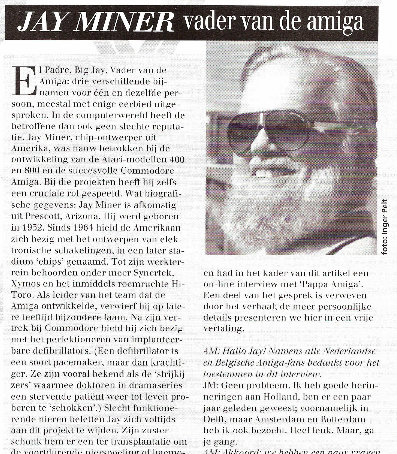
AM: Drool... And utilities... Maybe PD?
JM: Not much lately, I appreciate Sysinfo and Tool Master (Jay probably means TOOL MANAGER by Stefan Becker, a program that appeared in the Task-list of his DLG Pro Bulletin Board program - Ed.)
AM: OK. Now a question about the good old days. What exactly were the differences between the Los Gatos 'Ranger' and the 'West Chester/Braunschweig' A2000A? As far as we know, both parties aimed for a machine with more slots...
JM: Yes, but Los Gatos didn't like the vertical slot construction, and the Ranger was very similar to the later A3000.
AM: Besides the position of the slots, there must have been other significant differences, right?
JM: Not really. Both design teams were limited by the budget and the existing chip set from developing something that would truly surpass the later A2000.
AM: Alright. Something else: in your opinion, what were the real decisive advantages of the Amiga compared to other systems, such as the MS-DOS PC and the Atari ST? Every Amiga fan seems to have their own preferences on this point, ranging from the Workbench to one of the custom chips.
JM: For me, the operating system is the decisive factor. I actually think we could have made a lot more of the custom chips, with more Memory-Bus expansion options and more display modes.
AM: Probably so (with enough time, but I suspect every manufacturer imposes a deadline on their developers, right?)
JM: Absolutely, and design is also the art of making compromises. Many of my former colleagues were aiming for a cheap gaming machine, while others (myself included) envisioned a more expandable computer.
AM: Glad you pushed that through, otherwise we'd be talking about Nintendo now instead of Commodore..! Is anyone from the original Los Gatos team still working on the Amiga?
JM: Not that I know of. Most of them are currently working on the upcoming computer-console from the 3DO consortium.
AM: Yes, when we heard who was involved in that project (including RJ Mical and the founder of Electronic Arts, Trip Hawkins - Ed.) we thought, 'Wow, the Amiga story is starting all over again!' What do you think of the 3DO?
JM: To be honest, I'm slightly negative about the whole idea that people will be playing and communicating via their TV sets. I like the computer itself, but I doubt there's a market for it.
AM: What do you think of Commodore's own 'hope for the nineties,' the A1200?
JM: WITHOUT GOOD PR, ADVERTISING CAMPAIGNS, AND SUPPORT FOR DEVELOPERS, IT ALL DOESN'T MATTER. COMMODORE IS DOOMED TO DISAPPEAR IF THIS CONTINUES. (Typed in capitals by Jay Miner - Ed.)
AM: But they probably don't have the huge budgets that are spent on advertising in the MS-DOS world.
JM: Yet they have enough money to pay themselves million-dollar salaries... (especially the two main Commodore heads, Irving Gould and Mehdi Ali, have been heavily criticized for this from various sides - Ed.) Good Public Relations don't cost that much if you have some imagination. However, the ads don't reflect the advantages of the Amiga very well. In my opinion, the people at Commodore just don't have brains.
AM: You're probably not alone in that opinion. But on the technical side: do you think Commodore has adequately handled the evolution of the Amiga?
JM: I think they've done a fairly good job in that regard. I haven't seen their new (AAA) chipset yet, but the specs sound promising. They should have switched to CMOS chips long ago. But their own chip factory (MOS Technology, Ed.) only makes the old NMOS type and they're too stingy to modernize it. Aside from that, Commodore has continued the development of the Amiga reasonably well, albeit somewhat slowly. However, their biggest problem right now lies with the software being made for the Amiga and the marketing. The machine's advantages for video and games are overemphasized, creating a one-sided perception. For the competing systems, a lot of good business software has been developed; maybe it doesn't multitask as smoothly and uses a less advanced screen and window system than the Amiga, but it's what the customer wants.
AM: Commodore has received quite a bit of praise for the development of AmigaDOS 2 and 3.
JM: Yes, but the average user doesn't really care about that. They want business applications with all the features. And no matter how well the machine multitasks, most people won't see the benefits unless Commodore emphasizes this advantage in their ads.
AM: Still, for many people, the Amiga will always be a very special computer. Which factors do you think contributed the most to making the Amiga more than just ‘a machine' for them?
JM: Again, the operating system. I think we should erect a statue for Carl Sassenrath someday!
AM: After so many years of chip design, are there still technical developments (in the Amiga field or beyond) that even leave ‘El Padre' perplexed?
JM: Yes! The last company I worked for was involved with implantable defibrillators, a ‘smart' kind of pacemaker that can treat a heart attack with various shock therapies. Thanks to the built-in digital and analog filters and analysis circuits, these devices can distinguish real heart attacks from ‘false alarms' and gradually increase the applied current during a crisis. The data inside it can be read later by a doctor, even if the patient has already died. I think the whole medical electronics field will grow significantly in the coming years thanks to modern chip technology.
AM: It seems you've spent your time as well as you did during the development of the Amiga. Such a gadget could save lives in the future. But to wrap up: the Amiga has actually ‘saved' many lives from MS-DOS as well.
JM: Yes, many people have told me that the Amiga has truly saved them: from suicide, from loneliness, through computer education, and so on.
AM: Suicide??
JM: Yes! A man who had lost his wife wanted to take his own life. But he came into contact with the Amiga and quickly became completely absorbed in it. He got so involved, and enjoyed working with the Amiga so much, that he overcame his depression.
AM: There's not much more a computer can achieve than that. Thank you for sharing this story and for the interview, Jay. We need to wrap up the conversation now...
JM: ...That's right, because dinner is waiting for me, and I'm getting hungry.
AM: Yes, we can hear it rumbling here... Any message from 'El Padre' for his parishioners in the Benelux?
JM: Absolutely! Keep an eye on that big indoor waterslide in Rotterdam – one of these days I'll be back...!
AM: In that case, we'll definitely prepare a warm welcome. On behalf of all Dutch and Belgian Amiga fans, thank you for designing ‘our' computer, Jay. And maybe see you soon.
JM: OK, until next time.
All rights to the original content belong to their respective owners. This webpage is intended for educational and informational purposes only and is not intended for commercial use. If you are the copyright holder and believe this material should not be displayed here, please contact me via my website, and I will remove it promptly.